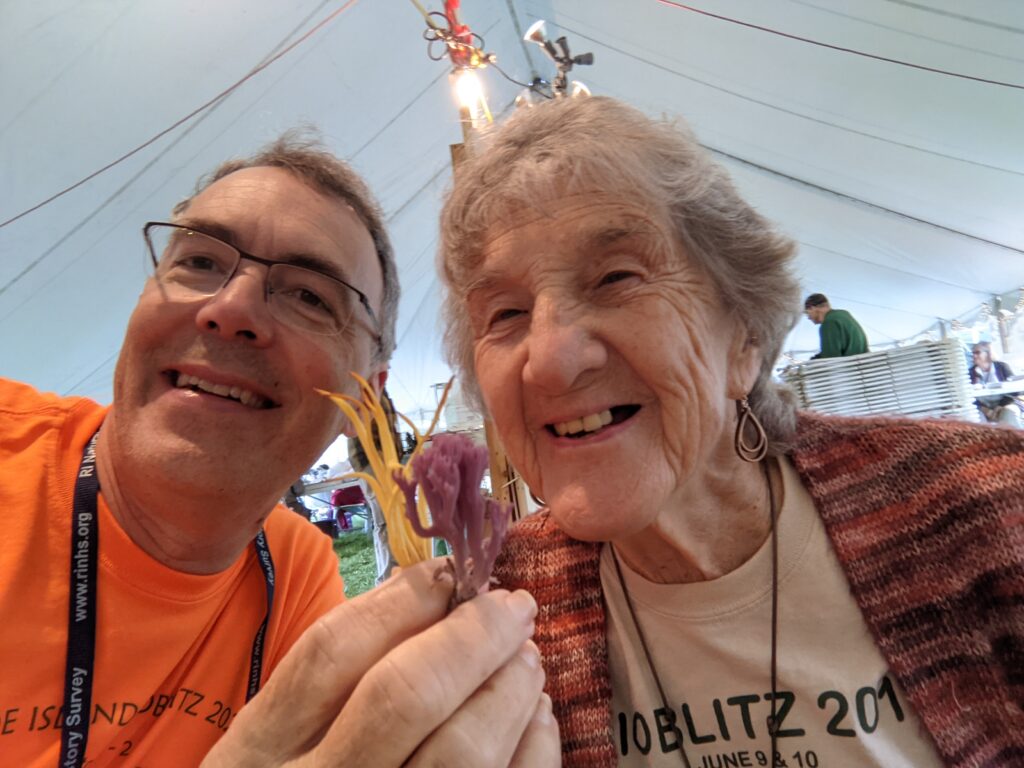
Helen Lusi received the Founders’ Award in 2022. She passed away on July 21, 2026, at age 98. The text below was written by Survey Program Administrator Kira Stillwell for the occasion of Helen’s award and published in the Rhode Island Naturalist on in Spring 2023 (volume 18, number 1, pp 19-21). It has been lightly edited to put it into the past tense.
I am honored to introduce Helen Lusi, and to share some stories from her life that help explain the notable role she long played in Survey events and her contributions in helping shape our future. Last summer, after the Survey Board named Helen the recipient of the 2022 Founders’ Award for Exceptional Service, I was tasked with delivering the news. After several years of COVID distancing, I was going to visit Helen! Awesome! I have had the good fortune to visit her at home, surrounded by gardens, several times—always a delight, a calm sanctuary insulated from the chaos of the everyday world.
During our visit, I shared the news of the award with Helen. She was predictably humble and thanked me but put it off like it was no big deal. From there, our conversations wandered broadly. Hearing stories from Helen’s childhood and of her formative connection with the natural world was gold!
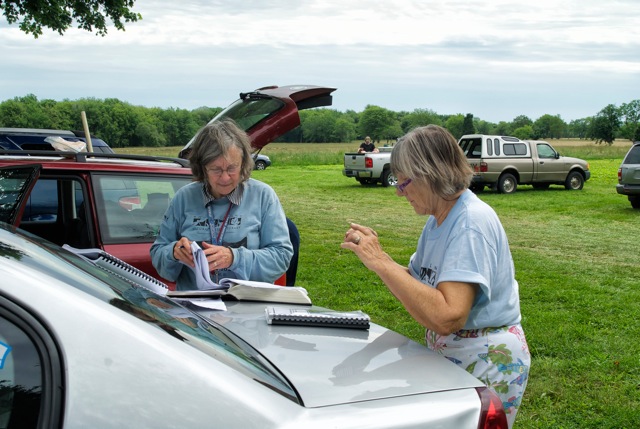
Helen grew up in Latrobe, Pennsylvania, southeast of Pittsburgh. Her favorite times as a child were visits to her Uncle John’s farm, where the farm’s plants and animals were surrounded by nature. She remembered that the most frequently uttered phrases during those visits were: “Where’s Helen?” “Where is Helen?!” “Helen!!” Helen of course was “out there,” she told me with a dancing gleam in her eyes. Her whole life Helen remained deeply connected to that place and time at Uncle John’s farm, always becoming misty with a somewhat faraway look as she spoke of it.
Helen grew up to be an elementary school teacher and a flower designer. Teaching children and working with plants were constants in her life. She found her way to Rhode Island and met the love of her life, Armando Lusi, known to all as “Gus.” They married in 1958 and shortly thereafter acquired a 5-acre, wooded dell in Johnston where they built their home. Over the next 60+ years, Helen cultivated native plants and trees to accentuate the natural features of the wooded property, creating a literal oasis. It was the perfect place to raise their five children in the middle of urban, and then mostly treeless, Johnston, and to instill in them her abiding love of the natural world and native plants in particular.
Years went by, the kids grew up, and plants remained a consuming passion for Helen. She was part of the creation of the Rhode Island Wild Plant Society, in 1987, serving on their board and in various support roles for many years. She was one of the cornerstones of the native plant “brat pack”—including dear friends Fran Underwood, Kathy Barton, Norm Boyer, Gil George, Ethel Halsey, Anne Wagner, and of course, the Survey’s founding director, Lisa Gould. I can imagine that Helen was the social director for this bunch!
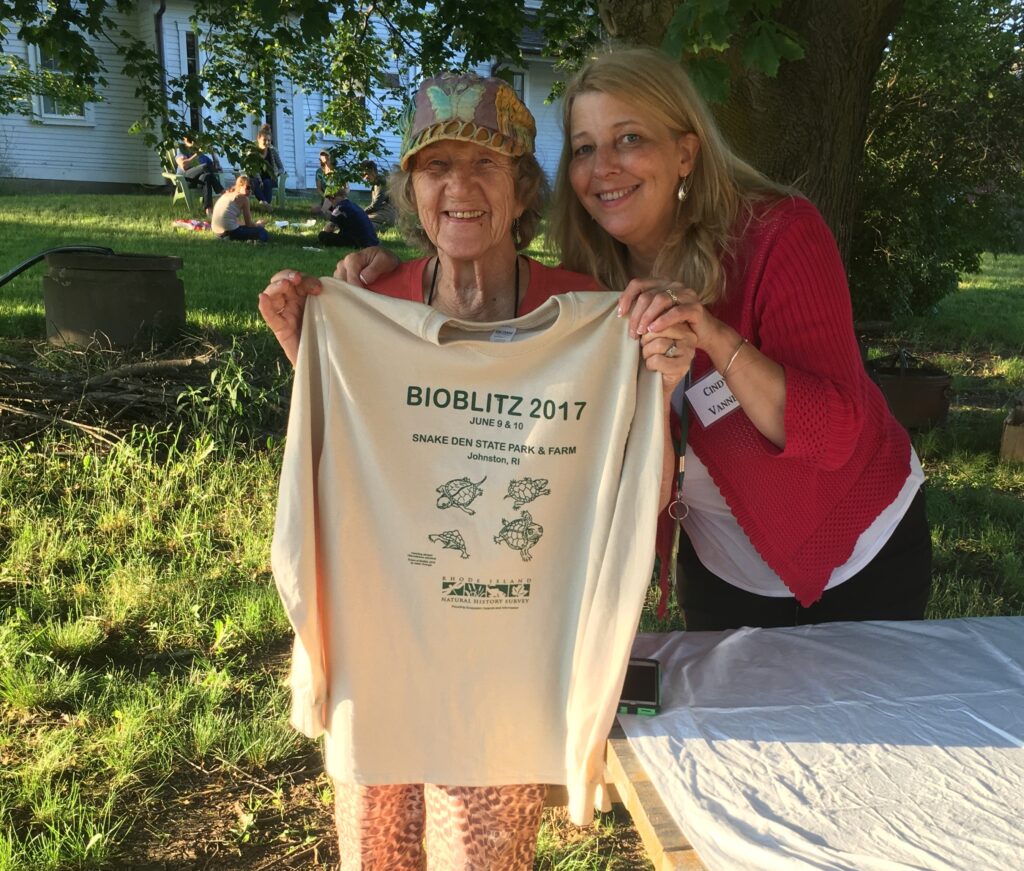
Helen was curious, enthusiastic, warm, genuine, and interested. When she asked a question, she “leaned in” to listen like the elementary school teacher she was, with her full attention. She became a Survey member in 2004, the same year that David Gregg and I started at the Survey. I’m not sure what inspired her to become a member, but we are grateful that she did and that she took to loving and supporting the Survey in her distinct way.
It was said of her, “Helen shows up”—in mind, body, and spirit. Helen showed up, so much so that (in botanist Hope Leeson’s words) it often didn’t feel like things really started until Helen arrived. Since 2004, Helen attended more Survey events—lectures, conferences, walks, award ceremonies, fundraisers—than anyone other than me and David and perhaps a few board members. She is the first one to buy raffle tickets and bid on auction items (and continue bidding to drive up the proceeds); she is the first one to get in line to buy a book by the author who just gave a talk. She brings acorn-flour cookies or some other gathered delicacy for the refreshment table, or a potful of wild mushrooms, cooked to perfection!
With only a few exceptions, Helen attended every BioBlitz since 2004, participating on the vascular plant and fungi teams. During lulls in her activities at Science Central, I often saw Helen observing with great pleasure and interest the school kids buzzing about—taking it all in and appreciating the magic that happens when kids have, as David says, “a minimally predictable encounter with nature.”
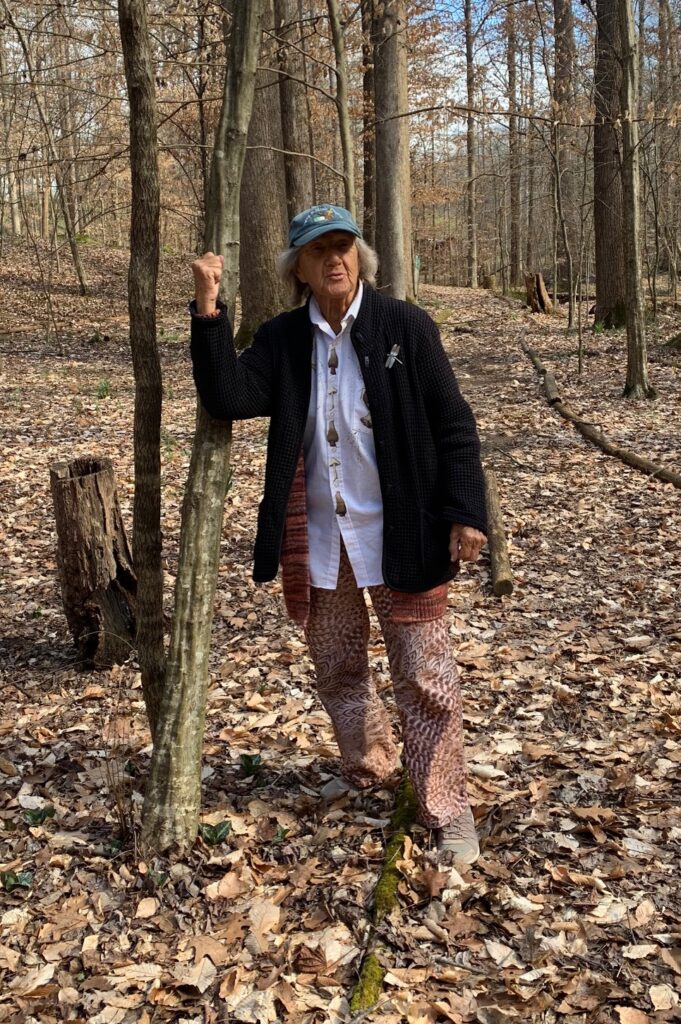
Helen suggested many times over the years that we conduct a BioBlitz at Dame Farm in her hometown of Johnston. So, when we announced that our 2017 BioBlitz was going to be held at Snake Den Farm, which encompasses part of Dame Farm, she was thrilled. Out of the blue, Helen called the Survey office to inform us that A.F. Lusi Construction, Inc. (under Helen’s direction in memory of Gus, who had recently passed) wanted to sponsor the evening meal at BioBlitz. Stepping in and showing up in such a way made a notable contribution to our work and helped fill the financial shortfall we always struggle with. Helen took me to a favorite local deli and we created the dinner menu. Those who were there might remember the Italian feast served in the barn. The highlight of dinner was Helen’s eldest son and family, including teen daughters, joining us for the meal and Helen touring them around—telling them all about BioBlitz and sharing an important part of her world with them.
A year or two prior to COVID, Helen invited David and me to her home for a visit. We sat around the dining table with her and family members, enjoying tea and cookies, and she challenged us with one of her perennial questions. How can you engage more kids in BioBlitz? She challenged us to make student participation in BioBlitz part of our routine planning. We talked at length about what that could look like, how we could do it and maintain our real science mandate without just making it into a field day for busloads of kids. My head was spinning imagining the challenges and the possibilities!
As tea was finished, Helen modestly stated that she had a financial gift planned for the Survey which would be earmarked for helping us to expand our efforts and hone our vision for what “student” participation in BioBlitz could be in practical application. Since that day she held our feet to the fire, showing up and continuing to ask us about kids at BioBlitz and tasking us with creating a new framework for how we approach our most notable annual event. As a result of Helen’s generosity, our way forward has included extensive efforts to incorporate more family-friendly events into our programs, and to engage more with faculty who participate and have students in tow.