“Order in nature must not be presumed, it must be demonstrated” ~Theophrastus
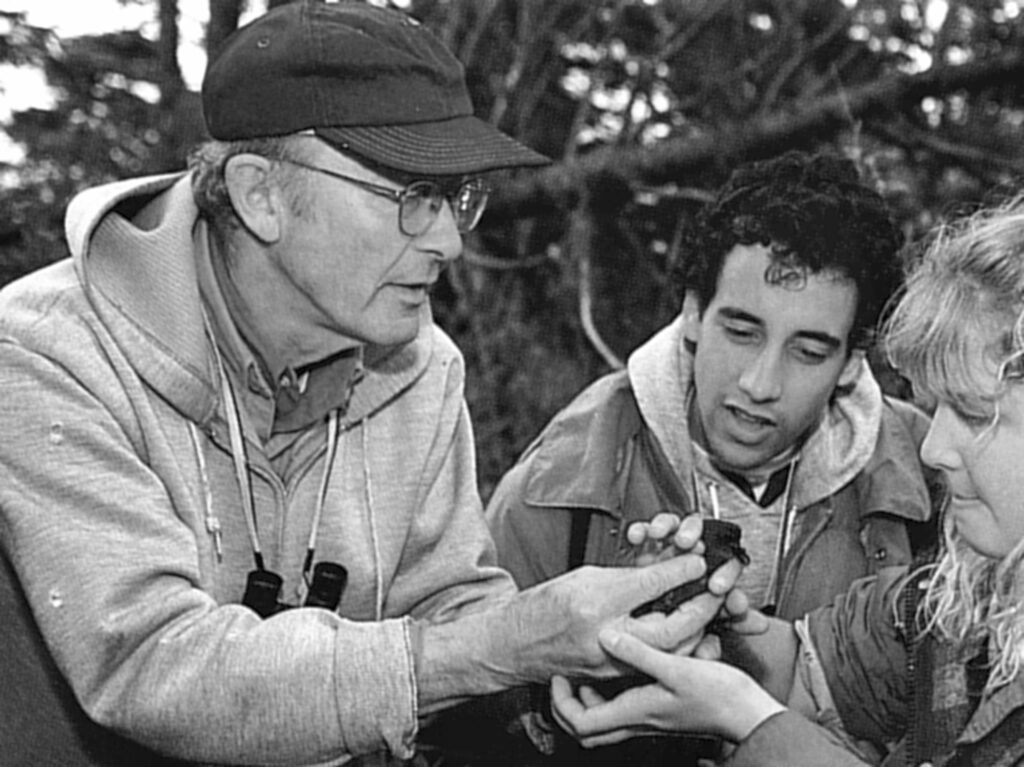
It gives me tremendous pleasure to present William Holland Drury, Jr., as a recipient of the Rhode Island Natural History Survey’s Distinguished Naturalist Award. Bill has been called a pioneering ecologist for his thinking on plant succession. But it was how he came to these thoughts that made him a pioneer. Bill Drury’s life was spent observing the natural world around him. He believed very strongly in the power of observation as the fundamental means to understanding relationships and ecosystem dynamics, and conferred great legitimacy to trusting one’s own observations and conclusions rather than relying on the established paradigm. Bill thought of himself as an ecologist in the old fashioned sense of the word: as a naturalist. Bill was also a great educator. He challenged his students, and anyone who would listen, to learn for themselves. One moment that has stayed with me for years, took place on our porch in Perryville in May of 1990. As we sat outside enjoying the evening air, we heard a call that had been puzzling me for weeks. I had investigated the possibility of grey tree frogs, but the sound came from high up in the tree canopy. Bill asked me what it was. I explained my dilemma. He said simply, “well, you’ll figure it out”. I did, it was the red bellied woodpecker (Melanerpes carolinus), a species which had recently expanded its breeding range to include Rhode Island. He could have told me that he knew the call, but he didn’t. And by not telling me, taught me something much greater.
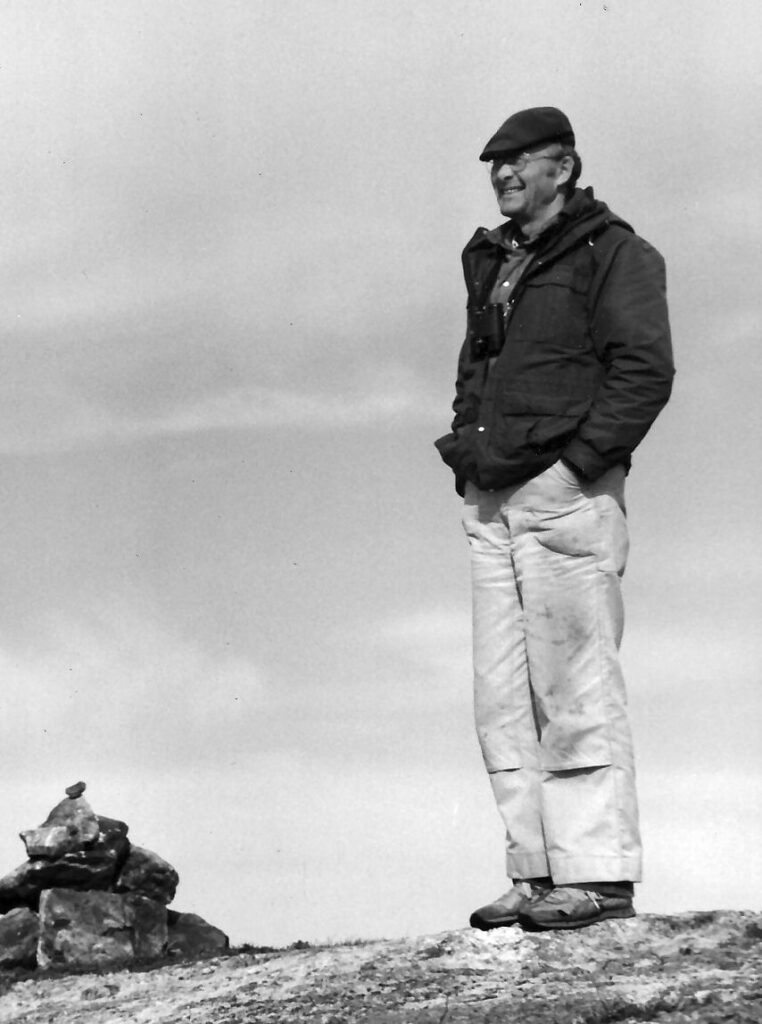
Bill Drury was born in 1921 in Middletown, Rhode Island; the youngest of 5 children and the only son of William Holland Drury and Hope Curtis Drury. The family lived on Paradise Road, set beside the ledges that now make up the Norman Bird Sanctuary, and the marshes, dunes and rocky shores of Third Beach and Sachuest Point. Theirs was a life that his oldest sister, Hope describes as “truly paradisiacal, outdoor living”. Bill’s parents were both artists and scholars, who instilled in their children the importance of reasoning for themselves, and instilled in them a healthy skepticism for the status quo. His mother was an amateur botanist who created detailed watercolors of native plants. His father taught art at St. Georges School, and was a well known landscape painter. When the Drury children were not attending to their rigorous home-taught studies, they were encouraged to explore the natural world of Paradise Brook, Grey Craig, Hanging Rock, Third Beach, Purgatory, Sachuest and wherever their legs could carry them.
For Bill that meant the ledges, marshes and coastal habitats where as a young boy, he became fascinated with birds. In his words, he was “preoccupied with finding new species and with drawing”. For as he wrote in an essay for an English class at St. George’s School, “drawing required that [he] watch individuals closely in order to recognize them by their personality and put that down on paper: their proportions, how they moved, how they perched…From this I formed my own pictures of them and how they interacted with their world”. As a teenager, Bill was able to persuade his teachers to allow him to substitute participating in a team sport for spending each afternoon walking 6 to 8 miles documenting the birds he encountered. It was on one such walk that ornithologist Roland Clement encountered Bill lying in a roadside ditch observing a flock of birds. Despite an age difference of about ten years, the two became birding partners and colleagues for life.
Field observations were Bill’s life-love. He could see no other way to truly study anything in the natural world. Bill’s graduate studies lead him to pursue geographic botany with Hugh Raup at Harvard University, for as he would later say to students at the College of the Atlantic, “I wanted to know the birds. In order to know the birds, I had to know the plants. In order to know the plants, I had to know the rocks.” Perhaps it was from these studies that Bill developed his capacity to see the natural world in the larger scale of geologic time.
The Middletown landscape and the birds Bill found there, formed the basis for how he viewed the natural world. I think it is fair to say that his intimate observations of, and relationship with each individual bird, and how they fit into the landscape were the beginnings of thoughts that would ferment later in life. Thoughts which continually returned to the process of natural selection as a result of the uniqueness of the individual.
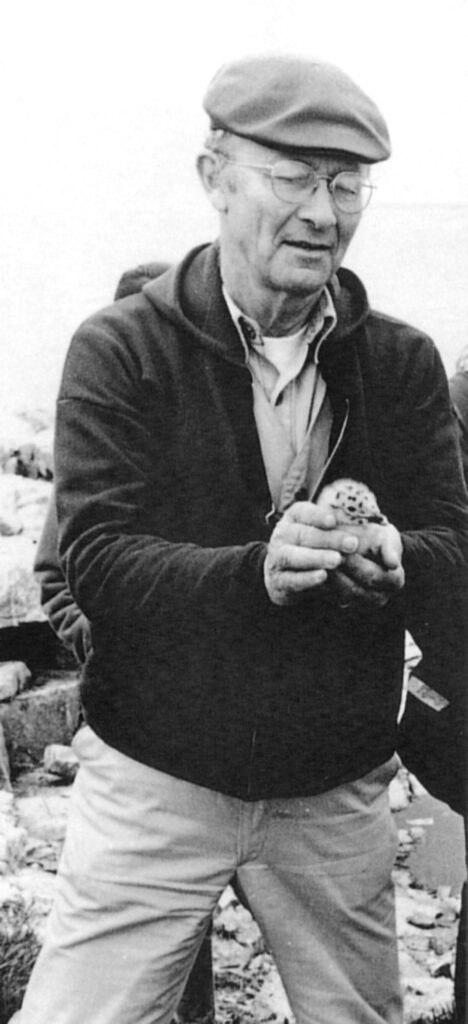
Bill was fond of recounting a formative event from this time. A professor, during a field botany class, searched and searched a hillside for a particular plant to show the class. The plant was in fact scattered all over the hill. However the Professor was not quite satisfied with any of these members of the population. Finally, with a great “ah ha!” he plucked an individual, and held it up for the class to see. This specimen, he said, “represented the ‘Typical’ of the Genus and species”. For Bill, this was an example of our “deep programming” (as he called it), and was an example of our tendency to conceptualize the natural world in some Platonic idealized order. Accordingly, one of Bill’s favorite quotes was from Theophrastus (sometimes called the Father of Botany), “Order in nature must not be presumed, it must be demonstrated.”
After graduate school, Bill remained in Massachusetts where he began a family with his wife Mary. In April of 1952, Bill Drury became the first person to observe and document the occurrence of the Cattle egret (Bubulcus ibis) in Massachusetts. An Old World immigrant, the bird is now fairly common from Canada south to Florida. For an interesting account of the day, read an article written by Roger Tory Peterson for National Geographic (“A New Bird Immigrant Arrives”, August, 1954).
From 1956 to 1976, Bill served as the Director of Research for the Massachusetts Audubon Society. It was in this capacity that much of his research on migratory songbirds and long term colonial seabird population surveys were conducted in New England. His research areas included coastal Rhode Island and areas north to eastern Maine. Ian Nisbet worked with Bill at Mass. Audubon, and in 1973 the two wrote their pivotal critique of the theories of succession. Bill’s observations in marshes and bogs around the country lead him to question the concept of a unidirectional and deterministic process of succession. The theory, Drury and Nisbet argued, neglects the force of natural selection. In their words, “That plants should release products which facilitate the growth of their own species makes better sense according to natural selection than that they should alter their habitat in such a way as to facilitate the growth of other competing species.”
In 1976, Bill Drury became a professor of biology and human ecology at the College of the Atlantic, in Bar Harbor, Maine. Bill’s teachings focused on observations of change and instability in natural communities, and on the role of natural selection in these processes. Bill recognized that deviations from the norm often resulted in new responses to environmental constraints that could result in important adaptations. Bill’s final contribution to the ecological community is his book: Chance and Change: Ecology for Conservationists. The book reflects on a life of observation and intellectual curiosity.
In his capacity as educator, observer, and thinker Bill Drury contributed a wealth of insight that provides context for understanding our natural communities in Rhode Island. As I reflect on the dynamics of species’ rarity and population change, I often think of Bill’s thoughts on the complex role human beings play in the natural selection of species, and of our role as gardeners in the ecological sense. When I am feeling the most confused, Bill’s oft spoken advice comes into my mind:
“When your views on the world and your intellect are being challenged and you begin to feel uncomfortable because of a contradiction you’ve detected that is threatening your current model of the world or some aspect of it, pay attention. You are about to learn something. This discomfort and intellectual conflict is when learning is taking place.” — William H. Drury, Jr., College of the Atlantic, 1991
Hope Leeson